Patient Education

Your feet may be the foundation of the problem

Many chronic foot and lower-extremity symptoms may begin with instability between the ankle and heel bones.
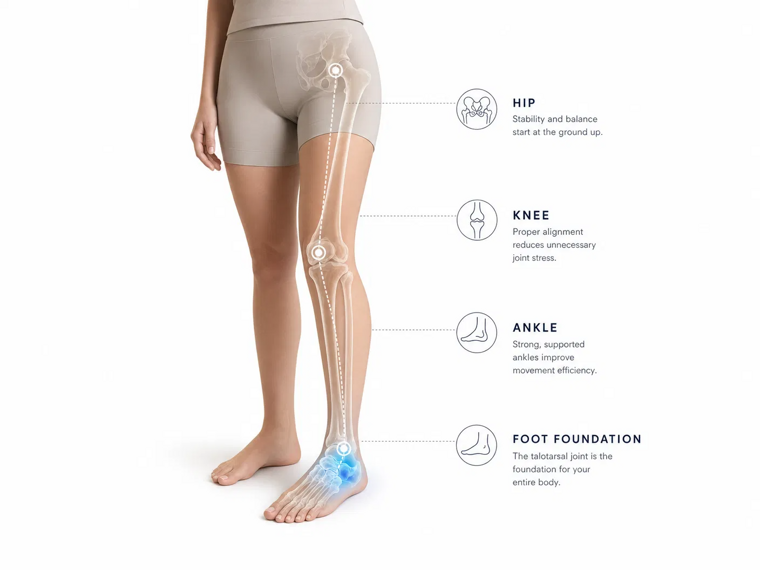
How hindfoot instability affects the knees, hips, and lower back
Understanding the Condition

What is RTTJD?

Recurrent Talotarsal Joint Dislocation (RTTJD) occurs when the ankle bone partially shifts out of alignment on the heel bone during standing and walking.

Over time, this instability may place excessive strain throughout the foot and body.

Dynamic Imaging
Recognize the Signs

Common symptoms

Foot Fatigue

Flat Feet

Heel Pain

Ankle Instability

Bunions

Shin Splints

Knee Discomfort

Hip Discomfort

Lower Back Strain

The Solution

A motion-preserving internal stabilization procedure

Extra-Osseous Talotarsal Stabilization (EOTTS) is a minimally invasive procedure designed to stabilize the talotarsal joint complex while preserving natural motion.

Lateral View Implant inserted — client asset
Lateral View Implant seated — client asset

The Phoenix™ implant is positioned within the sinus tarsi to help support alignment during standing and walking.

Minimally Invasive

Outpatient Procedure

Preserves Natural Motion

Designed to Support Alignment

May Reduce Abnormal Strain

Reversible if Clinically Necessary

What to Expect

Understanding the Phoenix procedure

The Phoenix™ EOTTS procedure is a minimally invasive, outpatient surgery performed through a small incision over the sinus tarsi. The titanium implant is positioned within this naturally occurring space to help stabilize the talotarsal joint complex while preserving natural joint motion. The implant is placed without cutting or drilling bone. The procedure is typically performed under local or regional anesthesia.
Recovery timelines vary by individual. Many patients begin partial weight-bearing within days of the procedure. Full recovery and return to normal activities may take several weeks. Your physician will provide specific post-operative instructions and a recovery timeline based on your individual case.
For patients with bilateral RTTJD, procedures may be performed on both feet simultaneously or staged over time. Your surgeon will recommend the best approach based on your clinical presentation, activity level, and recovery goals.
Conservative treatments for RTTJD may include custom orthotics, physical therapy, bracing, and activity modification. When conservative measures fail to provide adequate relief, surgical intervention such as EOTTS may be considered. Your physician will discuss all available options.
As with any surgical procedure, EOTTS carries potential risks including infection, nerve injury, implant displacement, continued pain, and the need for additional surgery. Your surgeon will discuss specific risks and benefits during your consultation.
A thorough evaluation by a qualified healthcare provider is essential to determine if the Phoenix™ procedure is appropriate for your condition. This includes a comprehensive physical examination, weight-bearing imaging, and discussion of your symptoms, goals, and expectations.
Financial Information

Understanding coverage & payment options

Insurance coverage for foot and ankle procedures varies based on diagnosis, insurance carrier, provider contracts, regional policies, and plan structure.

Some aspects of care may be covered while other components may remain patient responsibility.

Many patients choose treatment because of the potential long-term benefits of addressing the underlying instability contributing to their symptoms.

HSA / FSA

Health savings and flexible spending accounts may be used toward eligible medical expenses.

Financing Options

Third-party financing may be available to help manage treatment costs over time.

Staged Treatment Planning

For bilateral cases, staged procedures may help distribute costs and recovery time.

Consultation-First Approach

Begin with a comprehensive evaluation to understand your diagnosis and treatment options before making financial decisions.

Frequently Asked Questions

Patient frequently asked questions

Common questions about the Phoenix™ procedure, recovery, and what to expect as a patient.

Phoenix STS is a small titanium implant designed to help stabilize the foundation of the foot by supporting the natural alignment between the ankle and heel bones.
Phoenix is used to help address instability between the ankle bone (talus) and heel bone (calcaneus), a condition commonly associated with excessive foot pronation and collapsing foot alignment. This instability may contribute to arch collapse, foot fatigue, and knee, hip, and lower back discomfort.
No. Phoenix does not fuse bones together. The goal is to stabilize the foot while preserving natural motion.
The implant is placed within the sinus tarsi area between the ankle and heel bones through a small incision on the outside of the foot.
Yes. Phoenix STS is considered a minimally invasive procedure and is typically performed through a small incision.
When performed alone, the procedure may often take approximately 15–20 minutes.
Anesthesia options vary and may include local anesthesia or general anesthesia. Your surgeon will determine the best option for you.
Weight-bearing timelines vary by patient and procedure. Your surgeon will provide specific guidance based on your case.
The goal of Phoenix is to improve alignment and stability, which may help improve gait mechanics and reduce abnormal strain throughout the body.
Many patients with heel pain also have underlying instability of the foot foundation. Stabilizing the talotarsal mechanism may help reduce excessive strain contributing to symptoms.
In some patients, unstable foot mechanics may contribute to bunion progression. Improving hindfoot alignment may help reduce abnormal forces associated with bunion deformity.
The implant is intended to remain in place long term, but it can be removed if clinically indicated.
Some patients may temporarily notice the implant as the foot adapts. Most patients gradually become accustomed to the stabilization.
All surgical procedures involve risks. Your surgeon will review the benefits, risks, alternatives, and expected outcomes with you before surgery.
Potential risks may include temporary discomfort, implant irritation, need for implant removal, and incomplete symptom relief. Your surgeon will discuss whether you are a good candidate.
You may be a candidate if you experience flat feet or overpronation, chronic foot fatigue, progressive bunions, posterior tibial tendon problems, or recurrent ankle instability. A proper examination and imaging evaluation are necessary.
Yes. In patients with instability in both feet, bilateral treatment may sometimes be recommended to help restore balanced alignment and gait mechanics.
Coverage varies depending on your insurance plan and geographic region. Some patients choose self-pay options.
Recovery varies by patient and procedure type, but many patients experience mild swelling and temporary soreness.
Contact Astra OrthoMed or use the physician locator section of the website to find trained providers near you.

The information above is provided for educational purposes only and is not a substitute for professional medical advice. Please refer to the Instructions for Use (IFU) for complete indications, contraindications, warnings, and precautions.

Ready to take the next step?

Consult with a qualified healthcare provider to determine if the Phoenix™ procedure may be appropriate for your condition.